


- by bike : 2h - Difficulty Easy
- Distance : 16.1km
- Vertical rise : 30m
- Public : Tous publics
Step 1 :
From Béhobie to the port of Hendaye-plage In Urrugne-Béhobie, between Pausu square and Joncaux school, take the path along the children’s playground to immediately reach the banks of the Bidassoa River. There is a bike path along the right bank of the river, passing in front of Pheasant Island. 1,6km further, ride along the duckboard path on a balcony over the Bidassoa River, then pass under the arches of the Hendaye-Irun international bridges. The path continues along the river (with a view of Hondarribia) and ends at the small Hendaye port of Caneta (3,6km). Continue along the coastal path on a wooden pontoon that goes under the Pierre Loti house, then follow the Chingoudy bay (4,2km) towards Hendaye-plage. At the beach of the nautical centre (5,6km) pass on the left of a roundabout to continue to follow the bike path. At the second roundabout, through an ally of palm trees, reach the port of Hendaye; take the road on the right to the pier of the maritime shuttle (6,3km) in front of the Sokoburu apartment block.Step 2 :
From the docks of Hondarribia to the canal of Amute The maritime shuttle allows you to cross the Bidassoa River and drops you off at the Spanish dock of Hondarribia (7,3km): follow the dock on the left, bypassing very quickly the cove of the port of Zarra (blue boat). Take the promenade on the Spanish bank of the Bidassoa River. At the end, the bike path goes up the Mola canal. At the small port, reach a double roundabout with a statue (optional access to the old town): go over the bridge on the left and then, at the traffic light, cross the avenue to continue on a paved path on the left side of a canal. At the next crossroads (9,2km), take the second street on the left and ride along a bike path on the left side of the road. After 1km, turn left onto Kosta Kalea Street and follow the N638 along the bike path (Amute Bridge).Step 3 :
From the canal of Amute to Plaza del Ensanche in Irun At the big roundabout of the Amute canal (10,6km), keep following the bike path on the right, along the N638, for 300m. Just before a small canal, cross the road carefully to continue on a stone path between canal and vegetable gardens. When you approach a concrete driveway, follow it on the left and pass by the properties. When you reach a boulevard, continue to the right and ride at a moderate pace on the sidewalk until you pass under a road bridge. At the Zubi-Muxu roundabout, go back up the Ondarribi boulevard (towards “centro”) on the bike path of the sidewalk on the right. At the top (12km), turn left and then right to cross the bridge over the railroad tracks and then ride along Irun’s main avenue, Colon Ibilbidea, which has a bike path as well.Step 4 :
From Irun to Béhobie Ride past the lively Plaza del Ensanche (12,5km) and continue for 300m along the main avenue until you reach a kiosk-bookshop and a playground. Near the kiosk, set foot on the ground and cross the avenue to reach the opposite sidewalk on the right. Quickly turn into a paved street that slopes down to the church of Juncal (13km). Pass to the right of the building to reach a park: stairs to be followed on the left, lead down to the street below the church. From there, follow Santiago Street lined with bars. At the end of the street, turn right over the bridge and immediately continue on the left onto a bike path (Chemin de la Baie). Follow the path along a wetland area (Osinbiribil) on the banks of the Bidassoa River. The walk returns in a straight line, along a canal, to the GI-636 (14,3km): ride along the avenue to the left, on the sidewalk. There is a bike path along the Bidassoa River to take you to the bridge at Béhobie. Take the international bridge to the left to return to the parking lot, on the French side.
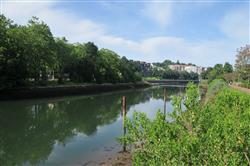 Pheasant Island (Nature site)
This modest island in the heart of the Bidassoa River is also known as the Island of the Conference: it was here that the Pyrenean Peace Treaty was signed in 1659 between Cardinal Mazarin and Don Luiz de Haru. Since then, the island has been ruled by the Spanish authorities for six months a year and by the French authorities for the other six months, making it the smallest condominium in the world.
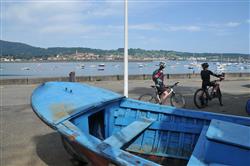 The port of Caneta (Heritage)
With its direct access to Chingoudy Bay, the port of Caneta was once a strategic location for sardine fishing, which is still celebrated during the traditional festive “sardinades”. A district facing Spain, fortified by Vauban as shown by the vestige of cannons turn towards Hondarribia.
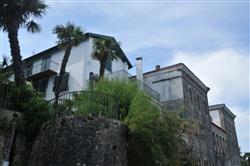 The house of Pierre Loti (Heritage)
The naval officer and writer Pierre Loti, author of the novel Ramuntcho, inspired by the traditions and customs of the Basque Country used to live next to the Moorish house, in a house with a hanging garden overlooking the Chingoudy Bay. His life ended in this house, which he called Bakar Etxe, the house of the loner.
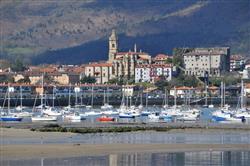 Hondarribia (Heritage)
Before continuing the ride, it may be worth making a detour to the historic centre of Hondarribia. To this end, enter the fortifications through the south gate. Go up Nagusia street to access the square d’Armes, its parador, its view over the bay and to look at the beautiful Basque houses.
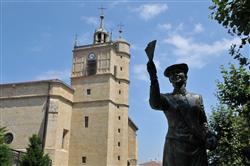 The church of Nuestra Señora del Juncal (Heritage)
It took a century to build this impressive Gothic-style church (16th century). With its ashlar façade and Basque influences, the building owes its name to the apparition of the Virgin Mary in the rushes of the estuary around 1400. The church then became an important stop on the coastal route to Santiago de Compostela.
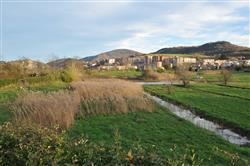 the Bidassoa marshes (Nature site)
The Bidassoa marshes (Iru-Kanale and Plaiaundi) enclosed between human constructions and urbanization are areas of great ecological wealth at the entrance of cities. Major rehabilitation and preservation efforts are being undertaken to maintain these areas of tranquillity for poultry (fauna).
Points to note :
- Irun, traversée de la N-638, très passante, s'assurer d'une accalmie dans le trafic (43.34955 ;-1.80336)
- Irun, tour du rond-point de Zubi-Muxu avec prudence (43.34550 ;-1.80157)
- Irun, avenue Colon, couloirs vélos signalés, mais trafic important (43.34101;-1.79756)
Nearby routes

As it approaches the Atlantic Ocean, the Bidassoa River settles in the…
URRUGNE
Circuit indicated by blue arrows to be practiced in the direction of…
URRUGNE
Circuit indicated by yellow arrows, to be practiced in the direction of…
URRUGNENearby accommodation
Agenda
Useful links
